| SHADOWS ON THE WALL | REVIEWS | NEWS | FESTIVAL | AWARDS | Q&A | ABOUT | TALKBACK | |||||||||||||
 Shadows off the beaten path Shadows off the beaten pathIndies, foreign, docs and shorts...
On this page:
THE GOOD LAWYER |
WHAT BELONGS TO OTHERS
| |||||||||||||
| See also: SHADOWS FILM FESTIVAL | Last update 27.Sep.26 | |||||||||||||
|
The Good Lawyer Un Bon Avocat Review by Rich Cline | 
| |||||||||||||
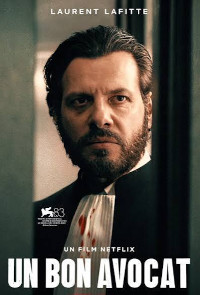 dir Tristan Seguela prd Simon Jacquet scr Marcia Romano, Simon Jacquet, Tristan Seguela, Stephane Sebag with Laurent Lafitte, Anthony Bajon, Melanie Laurent, Carole Bouquet, Gwendal Kerdelhue, Patrice Mendes, Francisco Yvan Luzemo, Gedeon Ekay, Sonia Chougar, Marv Trim release WP Sep.26 vff 26/France 1h54  Is it streaming? |
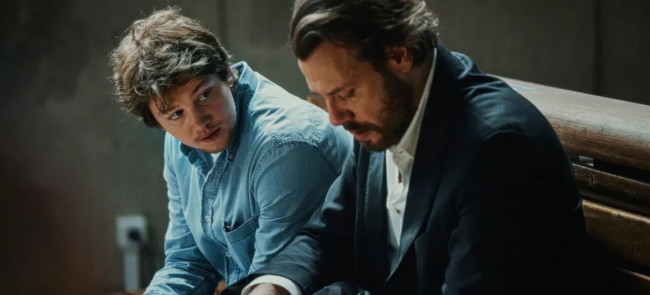 Punchy energy infuses this French drama, as lively camerawork and editing combine with a muscly script and strong performances to propel the audience through the twists and turns of one week in the life of a lawyer desperately trying to cling to his job. Filmmaker Tristan Sequela keeps the focus tightly on Laurent Lafitte's brilliant but outrageously messy attorney as he is forced to confront his own integrity. Representing drug dealers in two trials, Leonard (Lafitte) has a cocaine overdose in court. After rehab, he hires intern Noe (Bajon) to help him fight to maintain his legal status. He'll also need his powerful old friend Iris (Laurent), president of the bar. But Leonard can't escape his dealer clients and their goons, two of whom are entangled with multinational CEO Anne (Bouquet), who isn't as benevolent as her company's image suggests. Now Leonard will need to solve Anne's sticky legal mess in order to win over Iris and save his clients. And hopefully himself. Leaping at a brisk pace, the script's complications repeatedly throw Leonard into new challenges. Some of this feels a bit contrived, as the various elements fit together perhaps a bit too neatly. Sudden moments of violence or insight come along just when the plot needs them. And a brief side-trip to the Congo adds a blast of international colour. But it's exhilarating to hang on for the ride, never quite sure where things might go next. And the sticky moral issues require us to think. Even with all of that, the film's most engaging element is the unlikely friendship between Leonard and Noe. Lafitte's blustery, quick-thinking lawyer sits in stark contrast to Bajon's rather timid, quietly intelligent intern. They continually eye each other up warily, but see through the surfaces to something more resonant than we expect. Naturally, Laurent and Bouquet are terrific in strong side roles as women whose moral lines perhaps aren't as rigid as they look. All kinds of ethical questions come into play along the way, starting with the point that a lawyer's job is to defend the indefensible, to make sure that their client is seen. The cases here feature big flashpoints including slippery charitable ideals, terrorism and organised crime, and Leonard is somehow able to leap from one to the next, coming up with brilliant ideas when needed. Clearly he is made for this, and it's entertaining to watch him begin to understand why.
| ||||||||||||
|
What Belongs to Others Cudze Rzeczy Review by Rich Cline | 
Is it streaming?
| 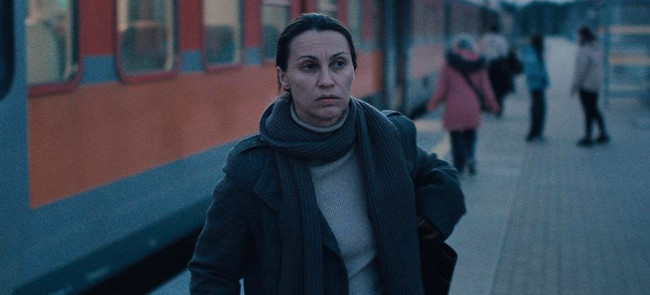 Shot in a bracingly matter-of-fact style with dialog that feels like it was captured by accident, this realistically gritty Polish drama centres on a woman who reacts unexpectedly when she has nowhere left to turn. Writer-director Grzegorz Debowski skilfully uses silent scenes to propel the story forward, allowing the audience to simply watch along, and to get increasingly involved in the thoughtful and rather darkly shaded narrative. Pressured by her landlord to pay for damage she didn't cause, Kasia (Kwiatkowska) and her pushy boyfriend Darek (Mania) pose as cleaners to break into apartments. Then Darek is arrested, and Kasia is evicted without notice, moving into a flat she knows is unlocked and empty. Aside, that is, from Piotr, who hung himself in a bedroom. Playing the griefing girlfriend, she calls the police. But as she goes through his stuff and settles into this new life, she becomes curious about who he was. And she's surprised that she truly feels connected to him. Kasia discovers that Piotr was a gifted artist, but no one seems to have known this. While getting in contact with his family, including his sister (Rozwadowska) and his (Kolan) ex-wife, Kasia has various offbeat encounters that begin to change her perspective on both this situation and her own life. She also begins to understand Piotr, including the depression that swelled up after his father's death. But her own criminal record haunts her, and Darek phones from prison to threaten her. Performances are grounded and understated. Kwiatkowska plays Kasia as if burglary is her only option for survival, an opportunist rather than a hardened criminal. Clearly her life hasn't been easy; she rarely smiles. But her deeper-running emotions make her likeable. By contrast, Mania's Darek is more persistently outside the law, an aggressive monster she seems inexplicably bound to. So it's no wonder that she begins to feel so fondly for the absent Piotr. Intriguingly, it's a woman with dementia (Pajak as Piotr's mother) who points out how harsh the world has become: "People used to care about each other!" Clearly, Kasia's main problem is that she hasn't cared enough about herself, so it's fascinating to watch her find a kind of offbeat romance with someone who can't love her back. And where the story goes feels rather nicely weightless.
| 
See also: SHADOWS FILM FESTIVAL © 2026 by Rich Cline, Shadows
on the Wall
HOME | REVIEWS | NEWS | FESTIVAL | AWARDS
| Q&A | ABOUT | TALKBACK | | ||||||||||